 Freelance
Traveller
Freelance
TravellerExploring Obsidian for Traveller
This article originally appeared in the September/October 2025 issue.
Part 1 - Pre-Design
The first step in any project of this nature is to answer a series of ‘what’ questions:
- What do I want to create?
- What do I want to display?
- What capabilities do I want to provide?
- What data will I need to have?
Most of the software grognards will recognize this as the “analysis” phase to get a grasp on the requirements for the project. I won’t dwell too heavily upon this, but my experience is that following some sort of organized process yields more success than just diving in and hacking away. However, your mileage may vary and you welcome to both your own opinion and processes.
For the above, I had the following answers:
1. What do I want to create?
An easy to use way to manage my RPG character(s).
2. What do I want to display?
The character stats, a portrait, skills, equipment and weapons. I'd also like to be able to easily get to personal history, service history and any vehicles / ships owned by the character. I also want to have any general notes that apply to most situations (encumbrance notes, enemies, etc.)
3. What capabilities do I want to provide?
A die-roller for 1-8 d6 and a wounds tracker.
4. What data will I need to have?
Obviously the character stats, equipment list, skills list, and personal information with regard to background, personal history and service history.
Supporting data will include stats for armor/equipment/weapons/etc.
High-Level Design
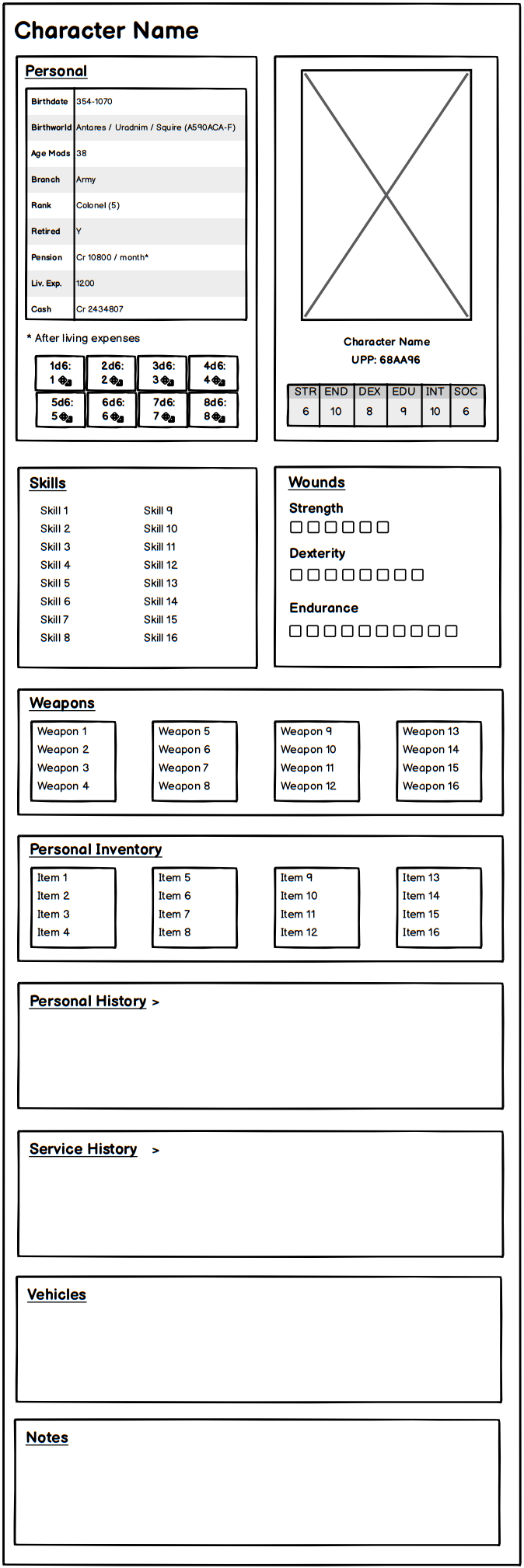
Figure 1: Wireframe for Character Sheet
Note that none of these are concerned with how I’ll do the implementation, but they do provide the basis for those considerations and result in a proposed wireframe that looks like Figure 1 (right).
Per Figure 1, you will note that I have a “block” for personal background, a block for the portrait and basic stats, A block for skills, a block for a wounds tracker, and sections for weapons, personal equipment (inventory), personal history, service history, vehicles and a catch-all at the bottom for general notes. The die-roller was included in the personal background block more for aesthetic purposes and to make it readily available as die-rolling is an essential game mechanic.
Design Decisions
The choices listed below document the design decisions I came to. You may choose to make other choices and that’s okay because there is no single “correct” way to do things.
Personal Background
The data in this section is relatively static and leans towards a tabular presentation. There is no indication that the data would need to be updated “live”1 so this will be a presentation-only section.
Die Rollers
The die rollers are presented as links with icons and when clicked will roll the stated number of 6-sided dices.
Portrait
The portrait is a static image and only requires presentation.
The UPP and tabular stats are also display onlyThis is slightly misleading as Obsidian notes can be edited in the edit mode. as they are not anticipated to require “live” updates.
Skills
The skills are presented as a display-onlyThis is slightly misleading as Obsidian notes can be edited in the edit mode., multi-column list. Like the UPP and tabular stats, the skill list does not appear to need “live” updates.
Wounds Tracker
The Wounds Tracker section consists of a series of checkboxes for each of the three major stats. These controls, while “live”, do not store state when the Obsidian application is closed. This situation can be remedied through the use of plug-ins or small Javascript snippets.
Weapons/Personal Inventory/Vehicles
These sets of data are presented as multi-column lists similar to the Skills section.
Personal History/Service History
These sections are accordion-style “controls” (note the right chevron by the titles) and can be expanded or contracted as desired.
Notes
The Notes section just contains any general information and is pure text. It is current not an accordion-style section, but it could easily be converted to one as the size of this data grows.
Tools
- The wireframe was created using Balsamiq’s Wireframes application. There are similar open source applications such as Pencil that essentially do the same thing.
- You can also use index cards to quickly sketch out the wireframes and then rearrange the cards until you're satisfied with your layout.
- This article series is being composed in Obsidian.