 Freelance
Traveller
Freelance
TravellerMurder on Arcturus Station
This article originally appeared in the May/June 2026 issue.
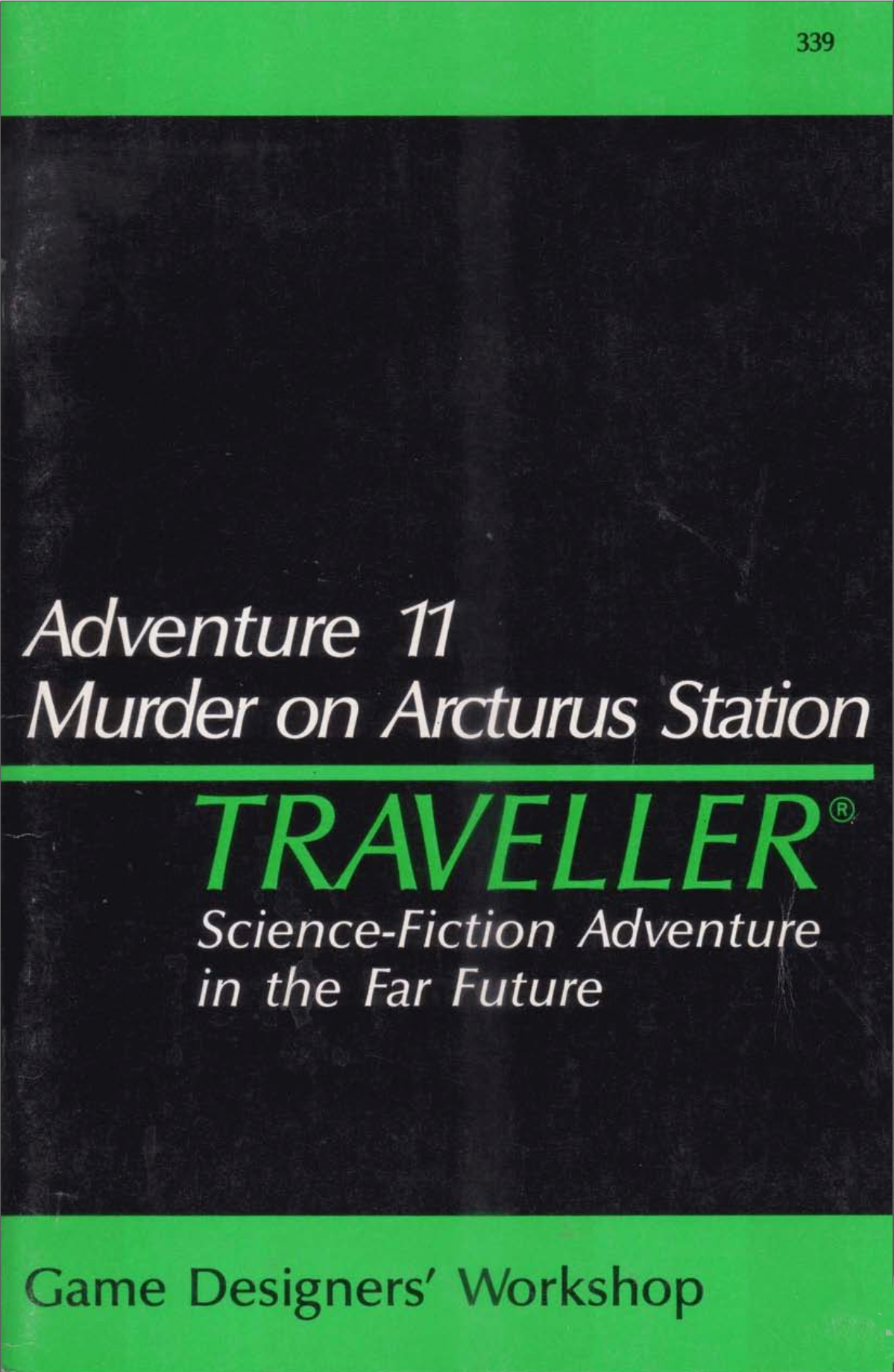
Murder on Arcturus Station. J.
Andrew Keith and John Harshman
Game Designers’ Workshop (defunct, see
https://farfuture.net)
57pp., PDF
US$.00/UK£3.78 (DTRPG) or included on the Classic Traveller CD-ROM from FarFuture
Enterpises
After my first read-through of this adventure, I was struck by the similarities between this (published in 1983) and what would, a few years later, become popular as “How to Host a Murder” (first published in 1985). The major difference appeared to me to be that it didn’t all happen at a dinner party. A second read-through pointed out the major difference that the basic assumption wasn’t that the dinner guests/player-characters were both the suspects and the detectives – although that was indeed an option.
The basic plot is that Someone Very Important has been murdered, and the local company manager asks the player-characters to find out who did it, before any “real” investigating authorities can get to the scene. If they can’t hand the investigator a solid, winning case when he arrives, there’s a good chance that the official investigator – an ambitious bureaucrat – will ‘play it safe’, not issue a detainer (or extend the station manager’s detainer) on outbound traffic, and end up allowing the real murderer to escape, while in all probability using the PCs as scapegoats of convenience.
Note: while there is some material that it is safe for the players to read, this is an adventure booklet that should really have been marked “FOR REFEREES ONLY”; the material that is “player-safe” can be reproduced and provide to the players as needed.
This is not an adventure that the referee can give a quick read-through of and then run it “off the cuff”. It requires a careful read (or several), and then subsequent planning, including selection of suspects (and which of them is the actual murderer). You (the referee) are provided with nine suspects, each with a possible motive, means, and opportunity, and the clues you’re provided with may or may not be “red herrings”, depending on how you decide on the details of the murder.
Guidelines are also provided for creating your own suspects, and there’s a section discussing how one can use the player-characters as suspects, if your gaming group’s interests happen to go in that direction.
Because of the flexibility that’s built in to the adventure as presented here, “re-playing” it is well within the realm of possibility; it could easily be played several times at intervals before starting to seem perhaps a little stale, just by changing up the details.
The introductory material (about four pages) offers eight pre-generated characters to use if desired; between them, all of the skills that the module indicates are desirable will be covered. The only materials needed by the referee other than this module is a set of core rules; several supplements are called out as being of potential interest for additional background information. There’s also background information that it is essential to convey to the players; while playing a little loose with the law is not unusual, there are certain apparently minor liberties which if taken will completely destroy their case and make the PCs potentially liable for unreasonably-large amounts of money.
This is followed by about four pages of “setup”. This can be relayed to the players as narrative, but it’s recommended that the referee allow the scenes to be role-played out. This is when the PCs are offered the job of solving the murder; if the referee has chosen to involve the PCs as suspects or with one of them as the murderer, their motive is also established in these scenes. If the PCs accept the job, they’ll be given access to the station’s facilities and they can ask station personnel for assistance (provided it doesn’t interfere with their normal duties). From there, it’s up to them …
The next five pages are guidelines for the referee when creating the adventure. The NPC/Suspect reaction table is here, along with a description of the format that the NPC suspects will be presented in later in the booklet.
A little more than two pages discusses the possibility of a player-character being the murderer; this can potentially complicate the adventure for everyone, as the PCs will ultimately either be working at cross-purposes (one trying to evade getting caught; the rest seriously trying to find the murderer and potentially discovering that it’s their companion) or having to work together to ‘frame’ one of the other suspects with an unshakeable case. (If the PCs are working at cross-purposes – that is, not working together to protect the guilty one – this adventure starts to move into the typical “How to Host…” model. I’d have to be convinced that this is a good dynamic for the group; it’s not unknown for in-character unpleasantness to occasionally spill over into real life…)
The next four pages discuss investigatory techniques, including rules for managing the aging and decay of evidence, what sort of information the PCs will be able to find (and with what difficulty), how they can go about finding it, and so on.
The victim and the crime scene are profiled/described over the next four pages. This will include some information that it is absolutely key for the players to know to investigate the murder adequately, but obtaining it isn’t a “gimme”; it will take knowing some other information before they understand that key information.
Twenty-one pages provide the information about nine suspects, in the format described in the section on creating the mystery. The referee will have information from this section on possible motive, means, and opportunity for each, along with reactions to various situations that may arise during the investigation, and connections between the suspects. This isn’t to be handed out to the PCs easily, but if they ask the right questions in the right way under the right circumstances, they should be able to obtain that part of the information presented here that will best further the referee’s goals for the adventure.
One page of short NPC profiles presents the key characters that the players will have to deal with at various times; none of them are suspects, and while one of them has set things up so the PCs can do the investigation even she will happily “throw them under the bus” if things go sour or the PCs exceed legality or propriety in their investigation.
The booklet closes with just over a page of Library Data that the PCs might need to obtain in the course of their investigation, and a page of Referee’s Notes that remind the referee that this isn’t set up like the typical Traveller adventure to date, and that this will take more work on the referee’s part than is typical.
I don’t feel that this is an adventure for anyone (referee or player) who is not of long experience and well able to separate player knowledge from character knowledge. It is very easy for this to turn into the players, rather than the PCs, trying to solve the mystery, and it really can spoil things if player knowledge “contaminates” the action. That said, this is definitely an adventure that should be on every experienced referee’s shelf, and it shouldn’t be too difficult to update it from Classic Traveller to more recent versions. If updated to the current Mongoose 2nd edition, a well-played character that has gone through Timothy Collinson’s “Consulting Detective” prior career, most likely as a “Holmes”-type detective, might make an interesting PC for this adventure.