 Freelance
Traveller
Freelance
TravellerBeltstrike
This article originally appeared in the March/April 2026 issue.
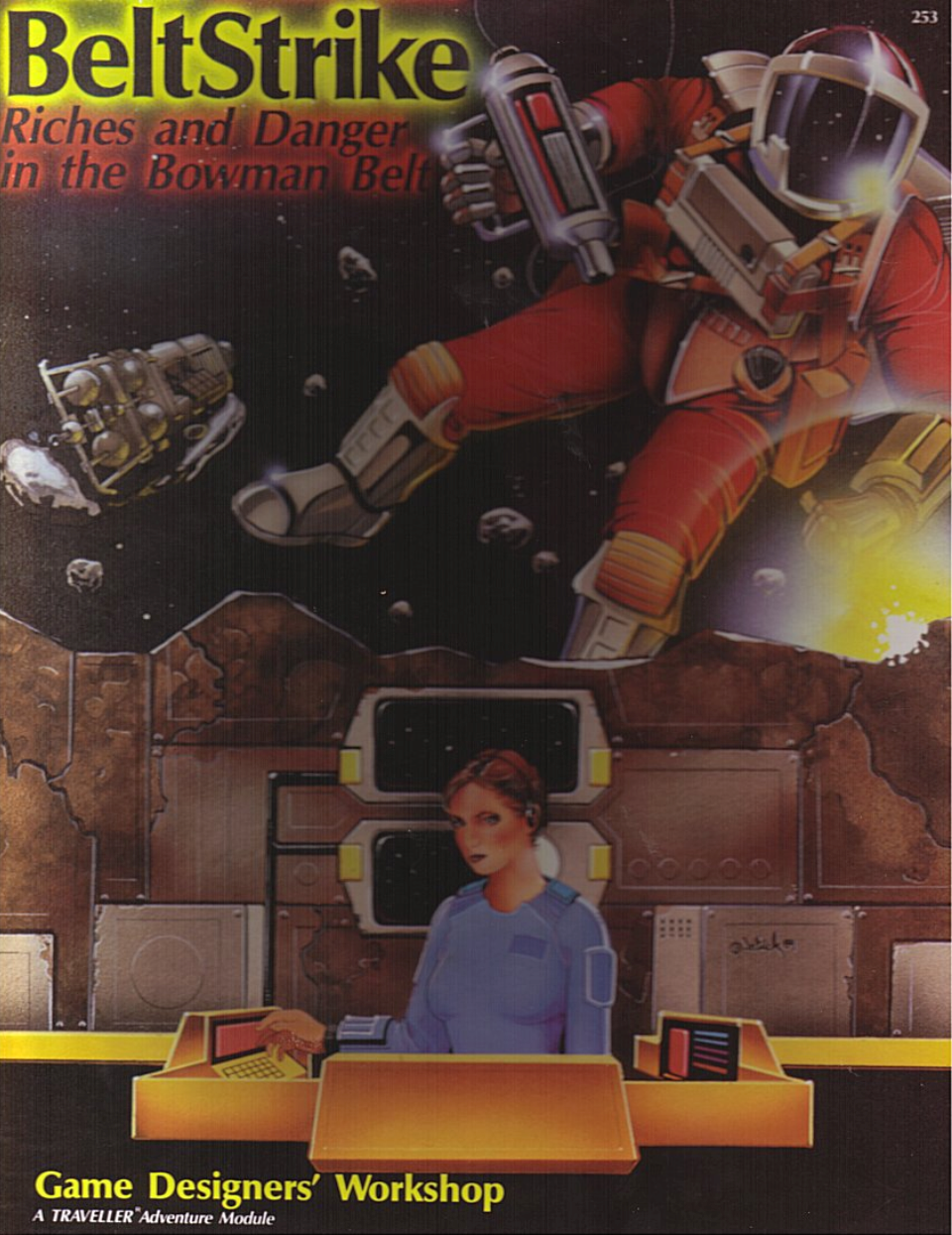
Beltstrike. John Harshman.
Game Designers’ Workshop (defunct, see
https://farfuture.net)
44pp., PDF
US$19.99/UK£14.68 (DTRPG) or
Available on the FarFuture Classic Traveller CD-ROM
The Beltstrike module adds to the basic rules of (classic) Traveller everything you need to be able to create and play belter – that is, asteroid miner – characters. As originally published, it was a boxed set with several booklets; the current availability from both DTRPG and the Classic Traveller CD-ROM folds all of it into a single PDF. The module consists of five parts:
- The Belter’s Handbook, covering the rules and other material for generating, playing, and refereeing belter activity
- The Bowman System Reference Book, describing the Bowman system, an Imperial client state on the fringes of organized Imperial space
- Four scenario folders:
Lodes of Adventure
,On the Rock
,Claimjumpers
, andArcheology
- A dozen character cards for characters that play important roles in the adventures
- A two-page map of Koenig’s Rock, one of the important locations of the Bowman system
The Belter’s Handbook is presented first. Although it explicitly claims compatibility with all of the then-extant versions of Traveller core rules (Starter Traveller, Basic Traveller, Deluxe Traveller, The Traveller Book), it specifically calls out Starter Traveller as providing the groundwork that Beltstrike is built on. It makes no mention of need – or even desirability – of anything beyond those core rules.
One exception to the core rules that is called out is that Belter characters may start their careers at age 14, rather than the age 18 of the core careers. Like the Scouts, there is neither commission nor promotion for Belters, and they get two skills per term instead of one. Tables corresponding to the standard core career tables are provided; the player or referee will not have to continually flip back and forth between this module and the core rules to generate characters.
All skills available in character generation are described in the core rules, except for the introduction of the Prospecting and Zero-G Environment skills. The latter is called out as equivalent to the Zero-G Combat skill introduced in Book 4: Mercenary, and is described in much the same terms. Similarly, the Mustering Out table’s ship benefit is for a 100-dton Seeker (a modified Type S Scout, details in the module), and there’s a minor limitation on the weapon that may be chosen for the weapon benefit.
Following the summary of the Belter character generation, the module describes setting up and equipping a belting expedition, and how to go about doing it, from complying with the legalities (which may or may not exist) to equipping a ship to actually going out and finding which rocks actually have something valuable, staking a claim, and bringing it in. There’s a section on “Belt Cartography”, or how a belt is naturally divided into regions based on the predominant composition of the planetoids in it. Depending on what a buyer might be looking for, any section may have valuable finds – but most finds are only barely enough to keep the miner going.
The next sections describe the tedium that is the basic activity of looking for the rocks that you can turn into a useful amount of money. They include rules for tracking character activity vs. time, and limit the character’s ability to work excessively long “shifts”. There are also special encounters and events that may occur, from poor maneuvering (and thus wasting fuel, cutting the amount of time you can be “out” prospecting) to distress calls (which must be answered) to equipment failure to various hazards that can occur during prospecting, mining, or even travel between a prospecting/mining site and a “base” to sell your finds at (and re-equip for the next venture out).
Zero Gravity and Low Gravity are important parts of the belter’s environment, and there is extensive information provided on working under such conditions and the hazards associated with them. There’s some math presented here so that you can calculate things like how high you can jump and how long it will take you to fall back to the planetoid – if you do fall back.
It’s noted that almost any type of ship may be encountered as a belter prospecting ship, but that some models are more useful than others. The example given in this product is the Type J Seeker, which is basically a demilitarized and stripped-down Type S scout/courier, with some additional minor changes to make it more useful for prospecting and mining. It is noted that conversions are done on Type S scouts that are sold out of service (as opposed to being loaned out to detached Scout personnel); the cost of acquisition and conversion runs about MCr25, and you get a ship with 40 years of wear-and tear, and the corresponding reliability. A non-jump-capable “mining platform” is also described; this is 5Kdtons of framework and equipment that allows for a total crew – including administrators, flight crew, technicians, and miners – of 175. Not counted in the allocation for crew is the ability to support ten Seekers (as a base).
Prospecting and mining takes special equipment; the next section provides basic information on some of the more important equipment available. This notably includes the preferred weapons of the belter, the Snub Pistol and the Accelerator Rifle (and the basic rules for character generation actually make it more difficult for a belter to choose a different weapon).
The Belter’s Handbook is rounded out by several pages of tables needed to implement the rules discussed in the earlier text sections. Organizationally, I think it might have been better to put the tables with the text that describes their use, but that might have been problematical for actually typesetting and printing the product.
The Bowman System Reference Book provides details and history of the Bowman system, on the fringes of the Imperium in District 268. As with The Belter’s Handbook, it calls out Starter Traveller as the basis for its development, but notes compatibility with Basic Traveller, Deluxe Traveller, and The Traveller Book. There is a note that adaptation to Traveller campaigns not set in the Spinward marches requires only that the system be located a short distance (in interstellar terms) outside a major interstellar polity.
While only a set of core rules is required, for additional ‘flavor’ the author suggests a number of other products that might be of interest. Of those suggested, I would strongly encourage the acquisition of Adventure 11: Murder on Arcturus Station; as it is set on a station in an asteroid belt not dissimilar to the Bowman belt, it could be modified and “dovetailed” into a campaign based on this module.
After presenting some “administrivia” – basically, outlining some ‘best practices’ for refereeing this module – The Bowman System Reference Book presents in-depth information on the Bowman system. There is an extensive (150 million km from inner to outer edge) asteroid belt and a gas giant at 270 million km from the M0V primary; the gas giant has a dozen significant satellites and a ring system, and provides an anchor for two groups of Trojan asteroids. There are a number of locations within the system that could provide interesting opportunities for adventure.
From the perspective of the player-characters, it’s likely that the most important of these locations is Koenig’s Rock, a dug-out planetoid that was a former naval outpost now given over to being a center – mostly lawless – for belter services. The module contains a map (spread across two 8½×11 pages) showing the layout of the Rock, and the businesses are identified in the System Reference Book.
There is an extensive history of the Bowman system, with the earliest known presence (a Darrian outpost) dating back about a thousand years before the founding of the Third Imperium. The system has mostly been a home for mostly-transient belters, but it has also been the site of both Imperial and Sword-World bases, and was also the site of the final surrender of the last active Sword World fleet to Imperial forces at the end of the Second Frontier War.
Library Data entries are a “mixed bag”. There are some entries of general interest which may have been repeated in other products, but most of the entries will have some relevance to belt mining, including brief descriptions of other asteroid belt systems in the Spinward Marches.
The last two pages of the System Reference Book are schematic maps of the Bowman system and the Bowman Prime gas giant’s satellite system, and a page of statistics on the system, including travel times and communications lag between various points in the system.
The “adventure” folders follow the System
Reference Book. Folder 1, Lodes of Adventure
,
is not itself an adventure; rather, it provides basic
information applying to the adventures in the other three
folders. There are also some suggestions to the referee for
appropriate “self-generated” adventures and
opportunities.
Folder 2, On the Rock
, provides information for the
referee to manage a visit to Koenig’s Rock, which will
be an almost inevitable part of any activity in the Bowman
system. Again, no specific adventures are provided, but a good
picture of a low-to-no-law startown can be developed from this
folder.
Folder 3, Claimjumpers
, provides the information
needed for the player-characters to go out prospecting, and
stake a claim if they find something worthwhile. This is an
actual adventure scenario; it starts with a belter approaching
the player-characters with a proposition that could be quite
lucrative – the belter purportedly knows where a major
“find” is, and wants the PCs to partner with him
to go to the find, stake a claim, and exploit it.
Unfortunately, some people learn about the “find”
who the player-characters and the belter wouldn’t want
knowing about it, and the PCs are surreptitiously followed on
their expedition to locate the “find”.
The players will eventually locate and stake the belter’s “find”, and now they need to get back to either Koenig’s Rock or out to Garrison (one of the moons of the gas giant) to actually file the claim and get it recognized and registered. This may prove to be a challenge, as an Imperial megacorporation is interested in establishing a monopoly on all mining in the system; the captain of the megacorporation’s mining platform in the system has ‘gone rogue’ somewhat and dispatched some seekers to attempt to ‘jump’ the claim. It’s up to the PCs to defend themselves against the attempts to prevent them from filing the claim, and the outcome of their attempts to defend themselves and to identify their attackers can affect the ultimate resolution of the scenario.
Folder 4, Archaeology
, goes off on a different tack.
Rather than being focused on belt prospecting and mining, the
player-characters are given an opportunity to be involved in
the exploration of pre-Maghiz
Darrian ruins in the system.
The scenario starts with a clerk at Garrison who the PCs know and are friendly with asking them to substitute on a run between Garrison and an archaeological team on Epsilon. This is because the megacorporate regular supply ship suddenly became irregular (that is, the regular supply ship made an impromptu change in its schedule). The players are asked to bring three scientists and supplies to the site on Epsilon, and find that the archaeologists, in addition to being happy about their supplies arriving, are also pleased about finding heretofore unknown information about the Darrian presence in the system. This includes discovering that there was a subsidiary outpost in the leading Trojan asteroid cluster, and the PCs are offered a contract to take an advance team to the Trojans to locate the outpost. Similar techniques to belt prospecting will be needed to locate the outpost.
The asteroid that the outpost is on also is the base for a group of belt-pirates (though the pirates know nothing about the existence of the outpost), and the pirates will try to keep the PCs and the archaeologists from getting back to Garrison, since both the megacorporation and the Scouts will be quite willing (and ready) to root out a nest of pirates.
The “preferred” resolution to the Archaeology
scenario will offer opportunities for continued involvement
with the exploration of the Darrian ruins, and this in turn
can lead to some notoriety for the PCs, which they may be able
to capitalize on.
All in all, this is both a solid and wide-open product, definitely worth having even independent of the Classic Traveller CD-ROM. There’s enough basic information that most of it could be used for belter adventures elsewhere, and even the scenarios can, with some work by the referee, be placed someplace other than the Bowman system.