 Freelance
Traveller
Freelance
TravellerThe Fifth Frontier War Sourcebooks
This article originally appeared in the May/June 2026 issue.
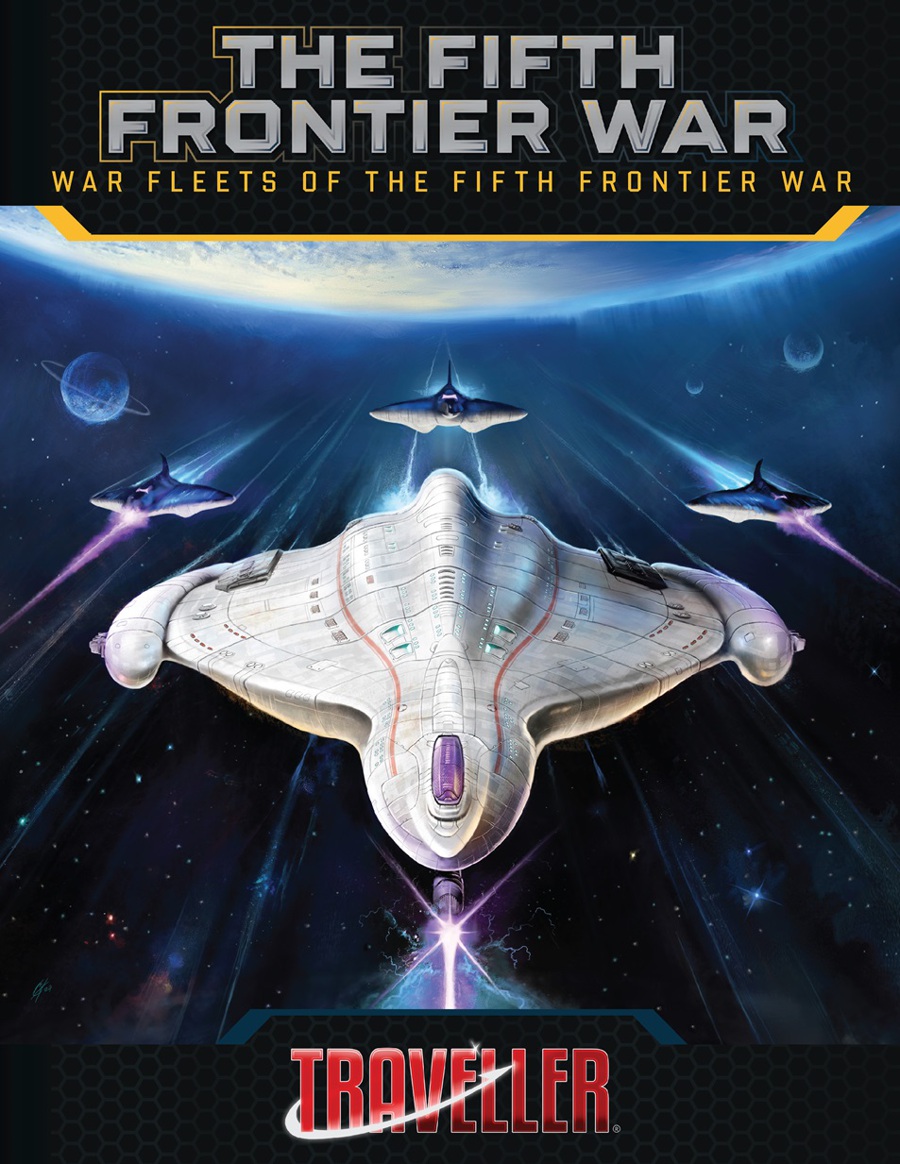
The Fifth Frontier War: Fleets of the
Fifth Frontier War
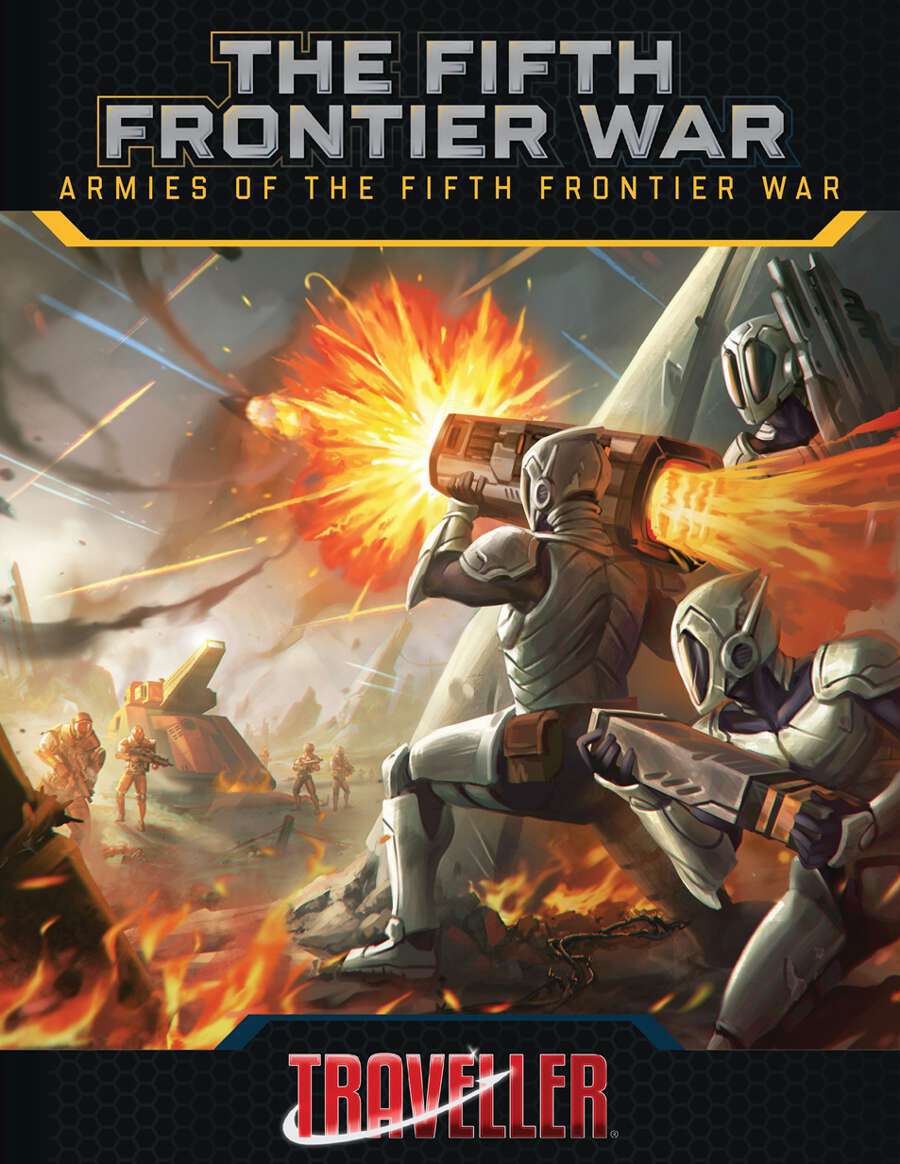
The Fifth Frontier War: Armies of the
Fifth Frontier War. both by Martin J. Dougherty
Mongoose Publishing https://mongoosepublishing.com
PDF, 175pp and 168pp., respectively
US$29.99/UK£22.06
Editor’s Note: DTRPG only offers these products in PDF, at the indicated price. It is probable that one can order printed editions direct from Mongoose Publishing at the price that Mr Collinson cites in the text.
There can be few old timers who don’t recall issue #9 of The Journal of the Travellers’ Aid Society [GDW] coming out in 1981. “WAR!” printed large on the front cover with an atmospheric colour illustration of a fighter over a city and landscape clearly under attack. The Fifth Frontier War had broken out and the news came as something of a shock, certainly a surprise and presaging no little excitement about what it might mean for Traveller. Something that loomed even larger when MegaTraveller introduced the shattered Imperium. (I was busy with a new job and new children when Traveller: The New Era came out so, while I dutifully collected the books, I never got to play it at the time and don’t recall feeling quite the same about Hard Times or Virus for example.) Holding the issue in my hands right now, I may not remember where I was – as I do for news of Princess Diana’s death in 1997 (the UK equivalent I guess of President Kennedy’s assassination which was before I was born), but I do remember the delight of reading Loren Wiseman’s ‘From the Management’ and realising that as slow as I am I had indeed missed all the “rather subtle publicity” GDW had introduced to pave the way to their big annoucement.
Now, of course the Fifth Frontier War, hereafter the 5FW, is old news and part of the furniture of Traveller in-game history. Indeed, one of my earlier adventures, Three Blind Mice was deliberately set in the run up to that conflict with the intention that sequels would begin to touch on affecting, perhaps not the outcome, but certainly trajectories of the war. Sadly that project from 13Mann never came to pass – although I do still have ideas!
Meanwhile, Mongoose, developing their Traveller line in various directions, have decided to make the 5FW a focus of a line of books. We have a core book, The Fifth Frontier War, two campaigns Opening Moves and Flashpoints and now two sourcebooks in The Fifth Frontier War: Armies of the Fifth Frontier War and The Fifth Frontier War: War Fleets of the Fifth Frontier War, hereafter Armies and Fleets rather than repeat the rather ungainly titles each time. Have I missed anything? It’s almost rather hard to keep up these days. Oh yes, see what I mean? There’s Bu and Embla Do the Fifth Frontier War, a freebie PDF download at mongoosepublishing.com and The Fifth Frontier War: The ICS Papers, a JTAS [Mongoose] sized booklet that came with the second tranche of boxed JTAS issues and can now be purchased separately.
This review will just look at the two sourcebooks. Fleets begins with a short introduction and then gets into some notes on the 5FW and the Imperial Navy. Then we’re straight into the big boats! Starting at a million tons! We have the 1,000,000-ton Duamu-class Heavy Logistics Ship, 600,000-ton Umkigu-class Fleet Tender, 200,000-ton Uashhki-class Second-class Battleship, 120,000-ton Kirkamshush-class Reserve Battleship, 8000-ton Aairlu-class Light Carrier, 3000-ton Duaan-class Gunboat Tender and 2000-ton Ukdargu-class Intelligence Ship. With ships this size of course it’s not really feasible to provide deck plans for each of them, but there are colour layout diagrams that work quite effectively in giving you an idea of what’s where. There are also good descriptions of the various operational parts of the ship. Using these, you could easily run anything from formal naval campaigns to hulks for scavenging travellers to pick over.
There are also two non-Jump ships: an 800-ton Piankir-class Light Monitor, 600-ton Patrol Variant Outrigger which get proper, if small, deck plans as do three “gunboats”: an 800-ton PBC-10 Heavy SDB, 600-ton SBC-12 Strike Boat and 400-ton PLD-12 Patrol Boat. If there’s a distinction between the Piankir/Outrigger and the gunboats (other than not having Jump drives), I must have missed it.
We’re not done yet however as there are also the usual details and deck plans for three colonial fighters: a 50-ton Larshan Utility Craft, 50-ton Larshan-Defender Light In-system Patrol Boat and 35-ton Sua Kai Heavy Fighter.
This section is finished off with seven pages of system security & defence doctrine so that budding admirals can replicate Imperial movements in high value systems and strategically important locations.
That’s by no means all, however. Then we move onto the Zhodani side of the equation. A brief, one page, introduction leads into more big ships than the Imperials get: a 400,000-ton Chiqurr-class Fleet Battleship, 250,000-ton Nechtliaz-class Battleship, 100,000-ton Yinsha-class Fleet Cruiser, 60,000-ton Ishdivda-class Raiding Cruiser, 30,000-ton Pe’chiaievl-class Fleet Security Vessel, 30,000-ton Adrzdrbiev-class Fleet Support Ship, 20,000-ton Kenskrafl-class Light Cruiser and 10,000-ton Sedapl-class Fleet Destroyer. Again, these get layouts rather than full deck plans. The following are small enough to have colour deck plans however: a 5800-ton Zhodrkijshev-class Assault-ship, 4000-ton Iazh Naflajesh-class Scout Destroyer, 3000-ton Eketlchi-class Freighter, 3000-ton Enche-class Intelligence Vessel, 3000-ton Ablavovr-class Covert Operations Vessel and 100-ton Ninz-class Interstellar Vessel.
In the non-Jump capable category are details and colour deck plans for a 50-ton Chredri Ivl Small Craft (& three variants: Kia-class, Iefdrel-class & Chaatset-class) and 8-ton Zdiezhi-class Light Fighter.
It’s fair to say that the ships make up the bulk of the book which is reasonable enough given the title and intent. There are some quirks of consistency where some ships (two or three) get their class name on the stat block but most don’t (which is singularly unhelpful) or get ‘Main Hull’ or ‘Standard Version’ which is scarcely more helpful, but this is a minor nit.
Moving onto Armies, there’s a longer introduction (4 pages instead of 1) and then we’re into a chapter called ‘Travellers and the Military’ which is good set of options for how this might be used for various campaigns or PC groups. There aren’t a lot of rules in the book but there are some for encumbrance and for drawing fire. There’s a good chapter (12 pages) on the 5FW from the perspective of ground forces (see Fleets for the Naval side) and then we’re into a chapter on ‘Military Organization’. Now this is the kind of chapter that a couple of friends at school would have lapped up as they marched lead tanks across a floor of green baize. I was actually expecting more of this and was moderately surprised it was only 11 pages. I might not have loved it as a schoolboy but these days I found it, sadly, rather useful in giving a better understanding of what’s going on in various news bulletins I see each evening from different parts of the world. I also quite liked being reminded of being an observer during said friends’ massed battles and at one time learning by osmosis to identify every kind of World War II panzer. The military ranks on offer here are close enough to the real world to be familiar and have proved useful across my life in both reading and life as I live in a military town and work in a naval city.
Next up is a large chapter that I know many have been waiting for or will particularly enjoy. ‘Weapons and Equipment’. And you won’t be disappointed. There’s loads, literally loads (see encumbrance) here. From the mundane Entrenching Tool (TL12 and dealing 2D+2 damage if need be!) to entire Battle Management Systems. Hand weapons, military sidearms, Zhodani infantry weapons, Sword World small arms, Imperial Marine weapons are all here. Then of course there is the armour and, ta da!, the Battle Dress or rather multiple versions of it (Infantry, Command & Assault) not to mention Zhodani versions (standard, Psi-Enhance & Teleport-enabled).
Just in case you think that’s all small beer, you won’t be surprised to hear that there are larger items on offer as well. Support & Vehicular weapons, Projectile Weapons, Artillery Rocket Systems & Mass Drivers, Battlefield Energy Weapons, Aerospace Defence. There’s a kind of grim satisfaction in seeing the damage columns of the stat blocks rise (along with cost). We get up to 8D of damage before moving into double damage and the Zhodani CCLS-Orbital Defence Missile, for example, which deals 4DD. With this and the gear to be found in the earlier book supporting mercenary actions, Field Catalogue, you won’t be short of some heavy (and lighter) firepower.
If all that’s not enough we then have a 48-page chapter ‘The Unified Armies of the Imperium’ which is perhaps the heart of the volume. This does what it says on the tin and details the overall picture heavily sprinkled with tanks (and other vehicles) along with the set up in twelve subsectors of the Spinward Marches (some getting less coverage than others if they’re further from the action). I’m particularly enamoured in this chapter of the unit patches that are lovingly created. I also liked the ‘history’ of the Main Battle Tank (the 45-ton, TL13 Makamda being “scheduled for replacement by a vehicle variously reported as Trepida or Intrepid” and expected in service in 1109. For those more familiar with MegaTraveller etc this kind of thing is a delightful gem. It’s not just tanks of course but also gunships, speeders and support. As with the equipment chapter all of these can be used as designed or can become prizes or cargo for more typical traveller groups.
Three more chapters round out the book: ‘The Armies of the Zhodani Consulate’ (27 pages) including, naturally, warbots, ‘Ground Forces of the Sword Worlds Confederation’ (8 pages) and ‘Ground Forces of the Darrian Confederation’ (6 pages). As you can see there is much less detail here, and perhaps fair enough. There’s certainly enough to be going on with if you’re on the Imperial side but want some materiel to be up against, but you’d have to do more work and invent more if you were, say, interested in playing Zhodani forces up against the dastardly Imperials. The TL15 Haveanan Grav Transport/Gunship for the Darrians is rather fun though.
Physically both books are the attractive and well produced hardbacks Mongoose is currently putting out. Branded of course as ‘The Fifth Frontier War’ and throughout using a distinct yellow and black styling which differs, rather attractively in my opinion, from the main line of books with their orange highlighting. Both have four-colour endpaper maps of ‘Opening Moves’ and ‘Imperial Response’ front and back, both have an index and each of them will set you back £40 in print and £22 as PDFs. (You get the PDF for free when purchasing the print). Fleets has 176 pages, Armies has 168 pages. The artwork throughout is high quality, attractive and to be commended although individual images are not identified as to artist. (The title pages tell us there were 8 illustrators involved in Fleets and 18 in Armies with some overlap.) Some are the grand sweeping depictions you might expect; some are more personal graphics with one or two sophonts in them. None of them seemed inappropriate or out of keeping as you sometimes got in 1st edition Mongoose books.
I wasn’t entirely sure why I was buying them as, even if I were to set an adventure in the 5FW, I very much doubt I would need this kind of detail, but I’ve been pleased I bothered as there’s more utility in them than I might have expected from the titles alone. For those interested in running military campaigns in space or on the ground in this time period they are of course a must. Absolutely chock full of details and ideas that will feed many hours of gaming. For those who want to set adventures of other kinds with the 5FW as a backdrop they’re a probable as you do get rules you might not use and all the military details which you could probably assume, but there are also ships to encounter, equipment to use (or ship as cargo), and people to meet. For those who just enjoy reading Traveller material and ‘living’ in Charted Space they’re a possible as it will depend on how much you want to get into combat related background like this. Having said that, the ship write ups or equipment notes or unit details are well-written, imaginative and inspiring. Which perhaps isn’t surprising from an author as experienced and well-versed in Traveller as Martin Dougherty. They have certainly made me, perhaps more the casual reader, really enjoy getting into the weeds of subjects I thought I’d skim through fairly rapidly. (Indeed, I hadn’t been planning on writing this review until some of the observations above started occurring to me and someone on social media said they’d look forward to my then-unthought-of review!) If, on other hand, you’re a casual gamer and enjoy Traveller but are not particularly fussed about the 5FW then it’s probably safe to give these a miss – unless of course you want crunchy, literally crunchy, ships and weapons that go boom in a big way.
These haven’t stirred in me the same feelings as JTAS [GDW] #9, but they have got me thinking about how one might run adventures in the interstices of what’s presented here and that’s no bad thing. Naval and Army characters will find lots to love here, and Referees will find material aplenty to get their players right into the thick of things with lots of Rich Decision Making Environments to fuel both combat and roleplay.