 Freelance
Traveller
Freelance
TravellerGURPS Aliens
This article originally appeared in the March/April 2026 issue.
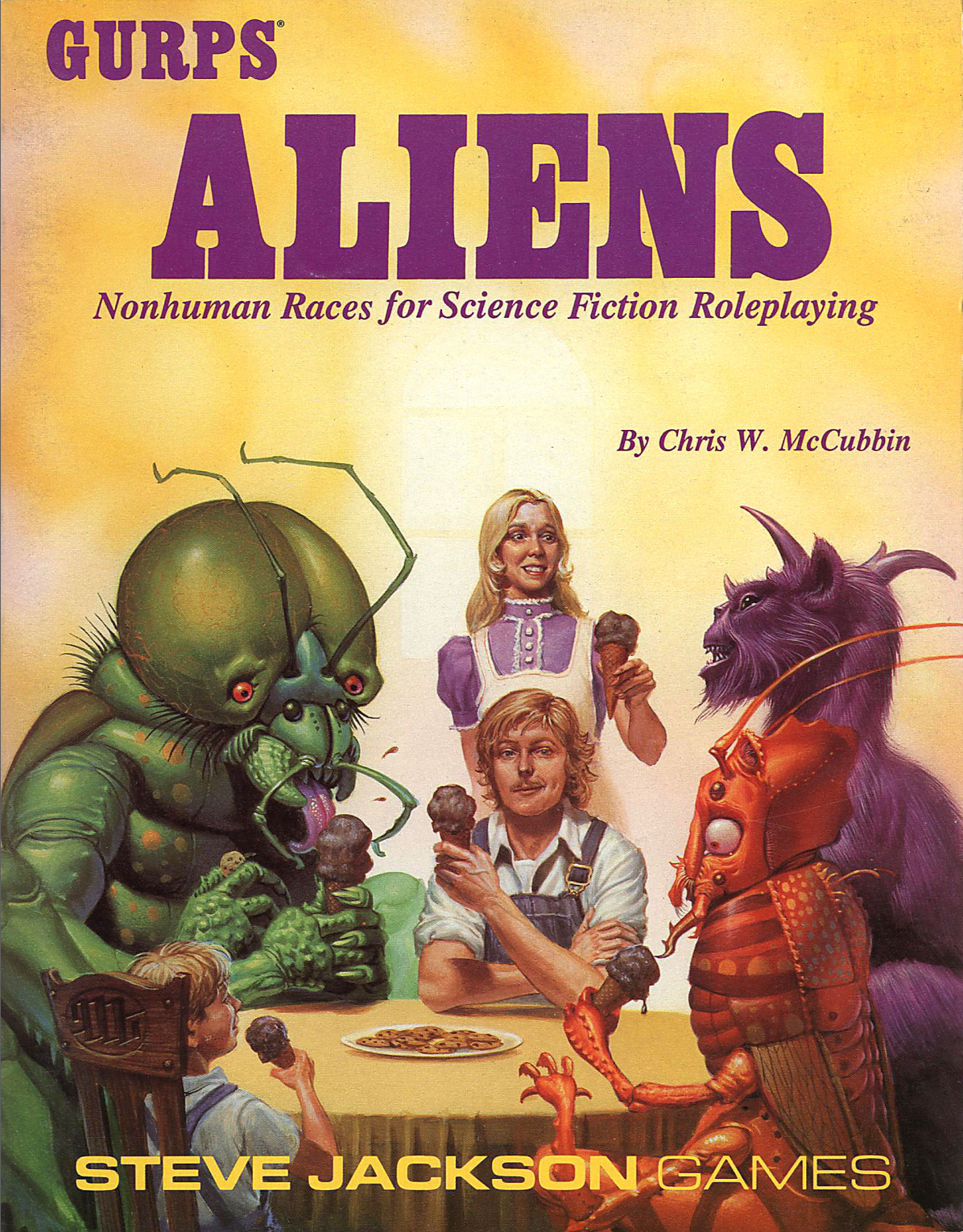
GURPS Aliens. Chris W. McCubbin
et alia
Steve Jackson Games https://sjgames.com
PDF, 130pp
US$9.00/UK£6.57
This product is for GURPS Third Edition.
Traveller has its sophonts of various types, but one can find ideas for alien intelligences in other places. One source that stands out – for both good and bad examples – is GURPS Aliens for GURPS Third Edition. This product provides some rules for generating nonhuman intelligences for GURPS (referred to as “the rule material” henceforth), but the bulk of the volume is description – at about the level of a “Contact!” article from the original GDW Journal of the Travellers’ Aid Society – of 28 different alien sophonts. Some of them seem to be suitable for “porting” into something resembling “stock” Traveller; others are … less respectful of my suspenders of disbelief. It should be noted that many of the suitable ones aren’t really different enough from humans socially, culturally, and/or psychologically that you couldn’t lift the relevant descriptive matter and apply it to humans of one planet or another in the stock Third Imperium setting.
The rule material starts by offering a distinction between “alien” and “space monster”, and the difference as defined here is at least as important to Traveller as it is to GURPS: A “monster” is a ‘one-shot’ obstacle to the player-characters in some way; once they get what they need from the “monster”, it goes away. Aliens, on the other hand, have a real and continued existence, and reappear (or at least should reappear) throughout the adventure or campaign.
Having defined “monster” vs. “alien”, it goes on to describe various campaign types in which aliens can play a part. On offer are the “First Contact” campaign, where the PCs are making the initial contact with a previously unknown alien race; the “Rare Encounters” campaign, where the aliens have been previously encountered, but so little is known about them that every encounter, few and far between as they are, is an opportunity to try to learn more; the “They’re Everywhere!” campaign, where aliens are so common, that you can’t avoid meeting them; or, for more of a challenge, “reflecting” any of these so that the PCs are the non-humans, and the “aliens” are humans.
The next chapter in the rules material focuses on creating alien races. Several “types” of aliens are defined; these tend to be defined in cinematic terms using clichés from fiction. There’s also some brief discussion of what I’ve called the “rubber suit problem”, essentially acknowledging that – for the most part – the player-characters will play aliens as “humans in rubber suits” whether that’s the referee’s intent or not. The actual process then described does not go into detail with die-rolling and table lookups; rather, it discusses the idea of conceptualizing the alien and then selecting characteristic modifiers, advantages and disadvantages, skills, and quirks that apply to all members of the race. There is then a section discussing how various “standard” dis/advantages should be modified into racial dis/advantages, and which “standard” dis/advantages can be used unmodified. There are also a number of specifically racial dis/advantages that are discussed.
After the rules material, the alien profiles are provided. There’s not a lot to say about this section in general; the characterization of each description being “at about the level of a “Contact!” article from the original GDW Journal of the Travellers’ Aid Society” really says all that needs to be said. The aliens provided do run across the entire spectrum of types outlined in the rules material; I’ve classified them somewhat differently for use in a Traveller campaign: some are “minor human cultures”, that is, if they were physiologically indistinguishable from average humans, neither their appearance nor their behavior would cause significant comment. “Compatible minor race” indicates that the presentation doesn’t really allow for substitution of human physiology, but there isn’t really anything in their description that would make them unusable in a standard Traveller campaign. “Incompatible” designates a race that seems to violate some fundamental assumption of the standard Traveller setting. Finally “Monster” in my estimation is a race that – even though they might not be “monsters” by the definition in this volume – could not coexist with the races of the standard setting, because of physiological or psychological issues that would in my estimation be irreconcilable. I list each of the twenty-eight aliens from this volume, my evaluation according to the above, and in some cases where I feel it necessary, some explanation of why they are so classified.
- An Phar:
- Minor Human Culture
- Auroras:
- Incompatible. I don’t see “creatures of pure mental energy” as being possible from any reasonable extrapolation of known science.
- Irari:
- Compatible minor race.
- Jaril:
- Compatible minor race. They could also be classed as “Minor Human Culture”, but some of the characteristics resulting from physiology differences can have a significant enough influence that I don’t feel that making them “human” is appropriate.
- Cidi:
- Incompatible. I have trouble with their size more than anything else; if you’re willing to allow your suspenders of disbelief to be stretched a bit more than I’m willing to allow, they could be squeezed in as Compatible Minor Race.
- Fasanni:
- I place these on the borderline between Minor Human Culture and Compatible Minor Race. This is mostly because I couldn’t quite decide; I don’t think that an entire human culture would necessarily have the characteristics ascribed to the Fasanni, but I’d have no issue with a single character being so portrayed.
- Gerodians:
- Minor Human Culture.
- Banduch:
- Incompatible. This might just be me; I just can’t envision psionic cow-sized brontosauri in a campaign. On the other hand, stock Traveller does have the (non-psionic) Virushi…
- Tamile:
- My gut reaction is to classify them as “Incompatible”, but I can’t really justify it. “Compatible minor race” is justifiable, just not in my campaigns.
- Memer and Saret:
- Incompatible. This is a suspenders-of-disbelief classification, like the Cidi; I think these creatures are both too small for sapience and too large for the physiology as described.
- Kaa:
- Incompatible, but this is because of their psychology and sociology as described; they’d have to be a Major Race in a “stock” Traveller campaign. They’re also slavers.
- Kronin:
- Minor Human Culture. In a stock Traveller campaign, they couldn’t be Imperial member worlds; they’re slavers.
- Markann:
- Incompatible. Any other race that knew of them would almost have to consider them monsters, with no possibility of peaceful coexistence.
- Verms:
- Incompatible. Quarter-tonne crabs seem a little improbable biologically; their psychology and sociology would render them as monsters to other races.
- Gormelites:
- Compatible minor race. If you want giant hairy semi-savages.
- Sparrials:
- Minor human culture
- Pachekki:
- Compatible Minor Race. The sex-switching (and personality-switching that accompanies it) are just a bit too far beyond the pale for me to be willing to classify them as minor human culture, Ursula LeGuin’s Gethens notwithstanding.
- Treefolk:
- Incompatible, IMO, but given the Llellewyloly, I suppose you could classify them as “Compatible Minor Race”. Llellewyloly notwithstanding, I really have problems with sophont vegetables.
- Purulu:
- Incompatible with a standard Traveller setting; Compatible Minor Race (or major race) in homebrew settings that aren’t significantly technologically different from the standard setting. The problem here is strictly their economic power; eliminate that and they become essentially obnoxious sophont octopodes, and probably not different enough from the Schalli (except temperamentally) to make it worthwhile.
- Traders:
- Incompatible. As soon as you start invoking the fourth dimension, you’ve broken my suspenders of disbelief.
- Truul:
- I have to give this a “Compatible Minor Race” rating since there’s already a race in canon where half of them are in (voluntary) slavery to the other half. Here, the whole race has the ‘slave mentality’, and it’s unfortunately going to be too easy to turn them into chattel slaves, prohibited by the Imperium – but play the right paperwork games, and you can get away with it. Not to mention the adventure opportunities…
- Engai:
- Incompatible. They’re Space Elves, really, with all of the advantages of classic fantasy elves (D&D or Tolkien). If you tone them down, they’d be “Minor Human Culture” – but you’ve got that with the Daryen anyway.
- Mmm:
- Incompatible. Given the limitations in RAW for psionics (continental range at best), a single interstellar hive mind just can’t be squared.
- Liook Sujan:
- Incompatible. Psionically-overpowered boulders with ranges well outside RAW for psionics.
- Riders:
- Incompatible. They’d have to be considered monsters by any sophont. This is, essentially, the biological version of the AI virus from Traveller: The New Era.
- Crystal Computers:
- Incompatible. Suppose the AI Virus of Traveller: The New Era gained psionic capabilities, and the early, hostile but not suicidal versions stayed dominant. Until they achieved psionic access to humans, the Crystal Computers are what you’d have. Once they do get access to humans, you end up with something a lot like the setting of Marc Long’s novel Misjump (reviewed in Freelance Traveller, Jan/Feb 2020).
- Gloworms:
- Incompatible. Monsters, in fact. I joke with parents about their five-year-old children being “energy vampires”. These actually are.
- Xenomorphs:
- All over the range from “Minor human culture” to “Compatible Minor Race”. Basically, any character might be one, but except in some very unfortunate circumstances, you won’t know it. If they were known to exist, they might well be considered Monsters, but not really within the definition in this volume. It should be noted that Mongoose did their own “take” on this idea in Cowboys vs. Xenomorphs, but I don’t own that volume and am not sure how compatible the “takes” are.
Overall, I think that a referee could get some useful aliens out of this volume, but I’m not convinced that the need for conversion to “classic-compatible” doesn’t reduce the value below “worthwhile”. If you’re playing GURPS Traveller, you could probably get away with bringing some of these into your campaign, and – quite frankly – I do like some of these better than some of the races I recall seeing in the various GURPS Traveller Alien Races books.